
This is a recording at the request of my dear friend Riviera in a very not soundproofed room in Seattle of Road Trip to Non-Commodification or How to Lower Your Rent and Raise Your Self Worth. To me, I said, looking squarely into the blue eyes of a man who'd trafficked me, you are inherently worthy. I didn't know then more than five years ago now why I said it. I hadn't planned on saying it. What I'd done with no speeches prepared was asked him to meet me in a public place so I could tell him I remembered the decade of sexual abuse.
Gabriel:And after I'd refused to hug him and sat down on a park bench and taken a deep breath, that's what came out. It strikes me now as a heroic act of compassion, my acknowledgment that he must have felt terribly unworthy to have done, to have been able to do what he did. My being able to acknowledge that he'd acted from a place of pain even then, relatively early in my treatment, shows me now how hard I must have been working from the get. I meant it, whether he was able to receive it or not. And indeed, he looked at me blankly and said, with the tone one uses to respond to someone who's being weird, okay.
Gabriel:Now it strikes me also as a manifesto. He was my dad after all, which meant I came from him by blood and by behavioral training. And while he had been capable of raping and selling me, I would never be able to treat another person like a non person, not even the person who'd done it to me. This is what surfaced when I woke up recently in the predawn dark in my house, which is also a truck, the morning after a landlord did not treat me like an extractable, minable resource for the first time since I started renting more than twenty years ago. Hello.
Gabriel:This is a roundabout way of saying from the evergreen state of Washington. My first week living in an RV, I met three queers at a park in Santa Cruz, each of whom spontaneously recommended Seattle for its extreme queerness, a strong recommendation coming from Bay Area queers. One of those queers also referred me to Thousand Trails, a national network of RV parks that members can stay in for two weeks at a time, then spend a week out, then go back in for two weeks, ad infinitum, for an annual fee of $500. What? I said, as all my friends said when I relayed this in turn.
Gabriel:Parenthetical, for the same referral rate? Call Stacy, 1877350612. Each membership is for a region of the country. Others can be added for $90 The zone I was in contained 19 campgrounds in Arizona, California, and Nevada. And so after three nights sleeping parked on the street and a week of renting spots among Santa Cruz woods and beaches in a way that would not be financially sustainable long term, I moved to a park with laundry and a pool and a sea of RVs spread out in the Central California sunshine.
Gabriel:My first day there, I looked up out of my back window from where I was lying in the squish, and I saw a giant pride flag hanging in the doorway of a shiny white trailer a few spots down. When I walked over, the owner gave me the names of three apps with places to stay and the required seven days out, Campendium, recreation.gov, Free Roam. If I just wanted to keep coming back to this camp, making my rent, including power and water and sewer and trash, $500 a year. It was an hour as well from a hot spring, which everyone knows is my favorite kind of place. I could stay here, I thought, having hooked up to all the utilities and checked out the amenities and settled into the peaceful okayness of it.
Gabriel:It was fine. I was fine. What's nice about the place you are right now? A friend asked, calling from the county where I'd moved out of my last apartment. Well, I said, thinking, I'm allowed to be here.
Gabriel:I recognized as it came out of my mouth that it was a fairly low bar, a refugee standard for a good place to stay. That wasn't nearly the end of it. The people were lovely, almost absurdly so. Do you want some candy? The guy working the checking gate one day asked me.
Gabriel:And when I asked what kind of candy, picturing a dusty little bag of Skittles, he handed me a large gift box of Ghirardelli chocolates wrapped with ribbon. One morning when I came back from the laundry room, there was a coat hung in the handle of my door, a fleece hoodie so giant and bonkers, white, interspersed with crudely rendered bears and pine trees. It was almost high fashion. And when I picked it up and started looking around confusedly, the woman in the next spot over leaned out her door and said, I'm giving that to you. You'll need a warm jacket, and I have lots of jackets.
Gabriel:But I didn't know anyone there. I could get to know people there, but by design, there's a lack of continuity in the community and a shifting sea of mostly straight and so far entirely cis people wasn't, I realized, community I most wanted to live in. It was too far for any of my Bay Area friends to pop over easily, let alone frequently. This is the queerest and most trans place I've ever been, said yet another homo and a trans one when we caught up by phone one day. We'd met only a few times when we both lived in the San Francisco North Bay, but he'd since moved to Seattle.
Gabriel:As it happens, I bought the upgraded Thousand Trails Pass that granted access to another 100 destination campgrounds near tourist hotspots across the country for an extra $330, and one of them was half an hour from his house. I woke up later that night, walked out my door, and walked up into the v in a tree trunk between two maples where I stood in the dark considering. By the next morning, I knew I was going to drive north. Do you have chickens? The potential landlord asked on the phone.
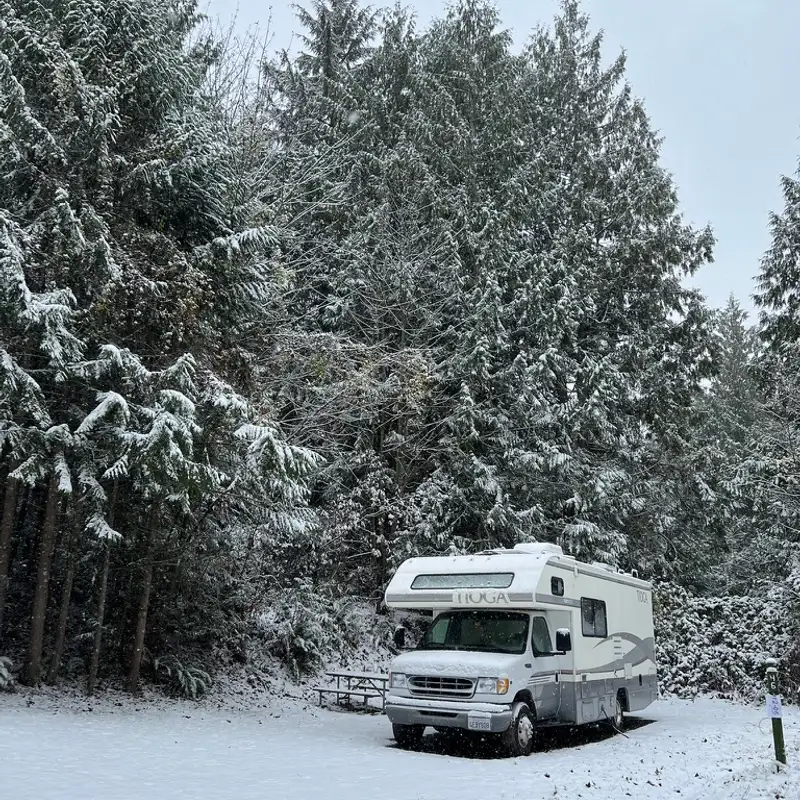
Gabriel:I'd been staying at the campground outside Seattle. This one had not just a pool and a hot tub, but also a sauna, which I trekked to through surprising and heavy snow for a week, which meant that in one more week, I'd have to leave for seven days. I started writing emails to farmers found through WOOF or creative googling because they had land, and I figured someone would take money to let me park on it for these interims. But I couldn't have fathomed I was gonna find what I did. I don't have any chickens, I said, laughing, caught off guard.
Gabriel:The landlord wasn't asking because it was a deal breaker, which is incredible. Also incredible, whatever amazing person is traveling around in an RV with chickens, given what people with pets are put through in regular renting processes. They just wanted to know if I needed enough space to accommodate landfowl. A week later, I pulled up to the property with a very generous agreement that I could stay for the night to see if I liked it. We'd talk about money if I wanted to stay, but no one seemed particularly pressed about it.
Gabriel:Further, upon my arrival, both of the adults who owned the property came out beaming, happy to see me. Stay, some internal wisdom said when I woke up the next morning, toasty in my parking space in the snow, space hater running ungenerously offered power from an outlet in their shed. I got dressed, took my bike down off my exterior rack, and cycled to the local grocery store. I sent some texts arranging a time to talk about what they'd charge me to stay. I got a debilitating headache while I waited, thinking about what I hoped for.
Gabriel:$50 a week was the best I could imagine but was probably hoping for too much. If they said a $100 a week, I could cover it on my current income if I went back and forth to the park. What they proposed was a $100 a month. They proposed I could stay there or not stay there as I wanted, as long as I wanted, whether leaving and coming back or not leaving at all, where there's water and power and Internet and pay them by the week at a rate of $25. We started this farm because we thought people needed us to grow produce, one of my landlords said the day I drove through their gate and followed their gesturing down the property where I learned various other people had lived in RVs.
Gabriel:It turns out what everyone really needs is a place to park. Three days prior, while I'd been waiting for the sauna at the RV to heat up at the RV park to heat up, someone in California had called my phone in delayed response to a next door post a friend had put up for me, asking if anyone with extra yard or driveway space wanted to rent it to a nice and conscientious person living in a vehicle. The woman on the phone told me she'd consider letting me stay on her property for $6,000 a month. I very politely, too politely, frankly, extracted myself from the conversation. A month before that, days before I had to vacate my apartment with a plan to move my stuff into an RV, but no RV yet successfully located or purchased, I'd reached out to a local queer organization that put me in touch with a lesbian who had an extra bedroom in a nearby apartment that, she told me, was both rent controlled for the last twenty five years and subsidized by Section eight.
Gabriel:She was willing to rent me her spare space for $800 a month, almost certainly more than the entirety of her rent. She might have some extra expenses coming up, she told me several times over, trying to justify this to us both. It's not news that rent is too high in general and offensively so in California. It is news to me that being treated as derivable by property owners and even other renters was reinforcing messages that I was worthless outside my profitability that had been embedded in me as a sex trafficked child. We so appreciated having you around, my last landlord said as I was handing her my keys.
Gabriel:I was drowning in exhaustion and stress, having acquired the RV one day before I had to move out. You have such great energy, she said, the real world worth of that being nothing, less than nothing. The reason I had to move out in such an awful rush without yet having the next steps in place was that when she'd found out I was even looking for an RV, she'd immediately terminated my lease. It is objectively gross. But when my friends and therapists said so, I outwardly defended it as a reasonable way rich people just have to act.
Gabriel:Those landlords spend most of the winter in Mexico, so wanted to make sure they had a new tenant before they might wanna leave. While inwardly, it rippled a deep reservoir of learned valuelessness, of undeservedness of anything better, of being unworthy of a basic level of consideration, like letting me legally terminate my own lease when I was ready, which would ensure I wouldn't become homeless, but made it remotely possible an exorbitantly wealthy person might lose a day or a month of passive income. I'd been evicted in San Francisco once, also by a rich person, and also when I was paying my full enormous rent, which was legal for them to do as a new owner, but which they still pursued by threatening to sue me. What I really felt wasn't, this is how people have to act. It was, this is how people have to act towards me.
Gabriel:I brought you a bucket, my new landlord said a day after my arrival, walking down the property to where I was parked near a thick stand of chibidats, also called Douglas fir trees. Actually, I bought you two buckets. Brought you two buckets. One with a toilet seat fitted over the top and another full of the thin skins that come off peanuts, which they get from a peanut butter factory. They compost their waste, and though there's a flushable toilet in my RV, they offered to compost mine if I was inclined to fill up said bucket with poo and peanut skins and put it outside, and then get it and empty it and clean it.
Gabriel:I'd be kept in fresh buckets, and my waste would be turned with someone else's labor into dirt food. The very first story I ever got paid for writing, $500, just like my Thousand Trails Pass, Sixteen years ago, it was about oh, Benjie's walking in. This is the upside of me recording this for you in the middle of an apartment. There's a person coming into it. Let's see.
Gabriel:Where was I? Can I just keep reading to you? Okay, in the process of that I just realized that there's a pause button on the voice memos on a phone which is what I am reading this into. I've switched venues. I'm now in a bedroom with a door.
Gabriel:As I was saying, the very first story I ever got paid for writing, $500 just like my Thousand Trails Pass, sixteen years ago was about my first husband and I encountering and arguing over composting toilets. Unlike those ones, the ones on this farm tolerate urine. So the next morning I woke up and walked into my bathroom and instead of peeing in the toilet peed in a bucket. Shortly after handing it to me, this landlord said something similar to my last one about my presence being refreshing, appreciated, and the difference is in this place I landed, it counted for something. Even my waste was treated as valuable.
Gabriel:Standing in the snow later that night as darkness fell earlier by half an hour than it does at my old apartment or in the sunny California campground, my new landlord told me it was brave of me to leave there for Northwestern Washington in the winter. And I told him that California, which I loved, was like many of my boyfriends, extremely beautiful, but hard and withholding. Ditto my Fancy Magazine career, which paid me 39 times more for my last story than for that first one, but also picked and pulled at and censored and squashed and exploited me. I remember dancing around elated when I got the offer for that first paid piece. There was snow outside there too in Ohio during my extended evacuation from Hurricane Katrina.
Gabriel:Here in Washington, after I took the buckets inside and the landlord went up back to his house, I danced around in my little truck home. It holds the entirety of my belongings and they're not very much and I have never ever felt like I was worth more.